“I also aspire to cultivate unique individuals who think critically and make independent moral judgements.”
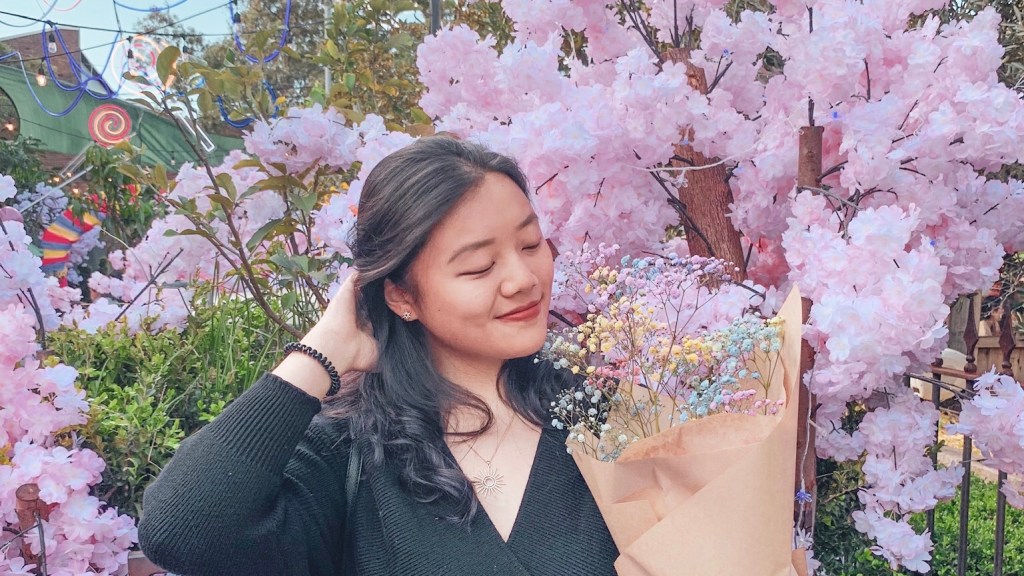
Celina is a third-year student at HKBU, studying English, English Education and English Literature. She loves taking photos, cooking, and playing the piano. (Head to the Gallery to meet her!)
Alison: Can you introduce yourself?
Celina: Hi! I am Celina. I am a Year 3 student studying the Bachelors of English and Education. My favourite pastimes are dancing (funky dance), playing the piano, completing DIY works, shopping, taking and editing photos, increasing the size and variety of my Winnie the Pooh collection, watching dramas, sleeping, eating… Oops, I seem very busy!
Alison: Haha, you sure do!
Celina: Since I was young, my dream job was to be a kindergarten teacher. But as someone who goes with the flow and adapts to spontaneous changes, I never really planned out my future studies. Honestly, my enrolment in the course I am studying is somewhat random. Thanks to my public examination marks, I’m walking this path now! But no worries, ’cause despite so, I have a strong passion for teaching and I strive to provide the best moral education to my students.
Alison: That sounds great to me. So, I have several questions for you today. Let’s begin with “what do you think is important in education for young children?”
Celina: As Gordon B. Hinckley rightly said, “You can’t build a great building on a weak foundation”. I think that education for young children must include both academic knowledge and moral education. They are the building blocks of a strong foundation, which contributes to enhancing a child’s psychological well-being.
In my opinion, moral education is the most important. This includes cultivating students’ personal and ethical qualities, values and attitudes. The way to do this is to motivate and guide students to become rational and independent individuals who are capable of thinking critically and know what is right and wrong.
Alison: As we all know, there are many aspects to a child’s education. How would you prioritise them?
Celina: First, I put aspects such as the mastery of knowledge, psychological well-being and ethical qualities on high priority as they constitute the foundation of a child’s education and development. It is essential to consolidate these three aspects. Once students are equipped with basic knowledge and good mental health, they can build up resilience and a high adversity quotient, which enables them to overcome obstacles easily.
It is also important for students to master personal and ethical qualities. In the long term, they have to develop a strong sense of conscience and consideration for other people to foster a harmonious social atmosphere. As I said before, they should also learn to distinguish right from wrong.
Second, I categorised intellectual development, aesthetic and cultural development and social, political, and civic awareness under the middle priority group. These are derived from the foundational qualities I listed in the high-priority group and determined by individual interest and motivation. For example, some students may value social, political, and civic awareness, hence they may choose to explore that by themselves. Some may value aesthetic and cultural development, thus they may focus on developing their artistry. As a result, schools don’t have to put that many resources on the aspects that students can expand on their own.
Lastly, I ranked self-learning ability, practical skills and social life at low priority. I believe these aspects can be achieved through students’ daily observations, social interaction and communication. Therefore, schools need not put extra funding on the areas that individuals can develop naturally when they are put in a school setting.
Alison: That is very interesting. I guess the aspects of a child’s learning process interrelate with each other – they can be categorised but they cannot be separated. Moving on to the next question, in your opinion, what makes a teacher “good” and what makes one “bad”?
Celina: I think five qualities make a teacher good and three make one bad. First, I reckon a good teacher should be positive. A school is a place for students to experience and experiment and teachers are very important facilitators. They should stimulate students to try different things and motivate them to work hard. They should have high hopes for students and believe they can succeed.
Second, a good teacher should be rational. The purpose of being a teacher is not only to transfer knowledge, but also to handle students’ behavioural issues. Rationality is key to making a fair judgement and determining the appropriate punishment.
Alison: These are really good points. Could you tell me why you chose to mention these two qualities first?
Celina: I based them on my experience in high school. I was the House captain in Year 11 and I had to hold an “enterprise” to sell snacks and drinks during recess. On the first day, I was just about to start selling when I heard someone shouting. It was my disciplinary headmistress. She was scolding some Year 9 students for buying drinks from the vending machines at the primary section, which is not allowed.
Supposedly, the headmistress should focus on the fact that those students misbehaved. But instead, she turned to me and yelled at me, “HOW MUCH IS A BOX OF LEMON TEA?”
I answered, “$2.50.”
“HOW ABOUT CHRYSANTHEMUM TEA?”
We did not sell chrysanthemum tea, so I answered as it is (with one of the Year 9 students helpfully adding that we did not provide it).
Then the headmistress scolded me, “Why don’t you sell chrysanthemum tea? Why don’t you remember the prices well? How can you be a salesperson?” She just carried on and on with a load of nonsense.
The thing was, WHAT WRONG DID I DO? She blamed me and my House for the students’ act of breaking the school rules. What sense did that make? Those students should have obeyed the rules regardless of whether the enterprise sold chrysanthemum tea or not.
The teacher was even worse. She should have spent time on reprimanding the Year 9 students instead of rambling on what I didn’t do.
Frankly speaking, it was really unfair. What did she expect? She had forgotten the fact that I was merely a student voluntarily helping out at school, trying my best to manage my studies (I was preparing for my public exam) and my House duties (being the captain, I had a dozen proposals, reports and meetings to attend to). I would be grateful if she behaved more rationally, instead of criticising anyone whenever she wanted to – she is known for being dramatic and unduly harsh. FYI, there was one time when she reported to the House moderator that I didn’t smile at her.
Alison: I see. That is why you think positivity and rationality are so important in a teacher.
Celina: Yes, I aspire to not be like her if I become a teacher.
The third good quality is being observant. I’m not sure if it’s just an Asian thing where teachers love using “efficient” ways to deal with “bad” students, such as through scolding and punishment. They tend to confront the students directly or even scold them publicly, which creates embarrassment. There are cases where students self-harm or commit suicide due to suffering pressure in school and receiving extra stress from a discouraging teacher’s words and actions. I believe teachers must always try to ensure their students’ physical and mental well-being. Therefore, it is important to be observant about students’ emotional states and both visible and invisible classroom behaviours. Words and actions should be chosen carefully.
Fourth, a good teacher should try to maintain a sense of equality between him/herself and the students. I think the Asian culture tends to promote a ‘students should respect teachers’ rule. Honestly, I agree. However, I have doubts as I gradually realise how some teachers misinterpret this principle and abuse their authority. They act as if they are more superior to students and always try to exert control. I don’t mean that students should not respect teachers, I just believe the respect should be mutual. Teachers are not only managers who assume and exercise authority but are also coaches who teach and cultivate, influencers who affect behaviours and enlighten thoughts, friends who share and offer help, and parents who nurture.
Lastly, a good teacher must be genuine. This is a piece of great and honest advice from one of my teaching inspirations. I have a lot of aspirations for teaching in the future, yet I’m still a student who lacks the experience and have no idea how to be a ‘good teacher’. What my teacher taught me was to ‘be yourself’. He said it will help me throughout my career. It sounds concrete but abstract to me at the same time. He explained further that teaching is neither a performance nor a show. The trick is to JUST BE YOURSELF. I was advised to treat my students genuinely because students can tell if I’m truly helping and caring about them or just pretending. Being genuine helps me develop individuality in my profession, and that’s how I gain respect from students.
Alison: I can’t agree more. These qualities exemplify what a “good” teacher is like.
Celina: As for what makes a bad teacher, I think the negative qualities are abusing punishment, labelling students, and having a negative attitude.
As I have mentioned earlier, some teachers – especially those in Asian countries – like resolving students’ behavioural problems by punishing them. However, they overlooked the question of whether this method is actually useful in bettering students and curbing undesirable behaviours.
I have another experience to share. When I was in high school, there was a teacher who abused punishment in class. She punished students who forgot to bring anything for the class to stand at the back of the classroom. Honestly, a teacher’s role is to boost the students’ engagement in class. Do you think students can learn properly when they are standing at the back? Or does that punishment constructively benefit students? I admit that this may be a good way to warn forgetful students. Nonetheless, I think the quality of the students’ learning should be of top priority. I believe there are better alternatives to use in the same situation. For example, the teacher can use a negative reinforcement method named ‘Grade Deduction’ to discourage students from not bringing the materials for the class. It is more effective and certainly much more reasonable
It is also bad to label students. Some teachers tend to segregate students into more and less capable categories, and often develop biased attitudes towards the students. This creates great discomfort to students and will demotivate them in their studies.
Finally, holding a negative attitude is a bad trait in a teacher. Teachers should always believe that students are capable and encourage them to achieve and aim higher. One of my worst experiences was being called “useless” by my House moderator. It’s a long story to tell, I just think this comment should be a taboo in the teaching profession. Teachers are not meant to label, criticise, or personally attack students like this. And to be fair, teachers do not have the right to say such things. This is contrary to a teacher’s required conduct!
Alison: These qualities are terrible indeed. I wouldn’t want to be taught by someone like this, nor would I trust my child with this teacher. My last question for you is, if you become a teacher in the future, what do you aim to achieve?
Celina: I aim not to educate groups of doctors, scientists, or inventors, but groups of responsible, disciplined, and considerate individuals who are physically and mentally healthy. I also aspire to cultivate unique individuals who think critically and make independent moral judgements. Lastly, I strive to provide as many diverse opportunities as I can for my students to act, experience, and experiment in their learning process so that they have the freedom to observe, think, and feel. By doing so, they can shine in their ways.
Alison: That is excellent. Thank you very much.
Find Celina at https://www.instagram.com/callmecelinie/!

 Speak Your Mind