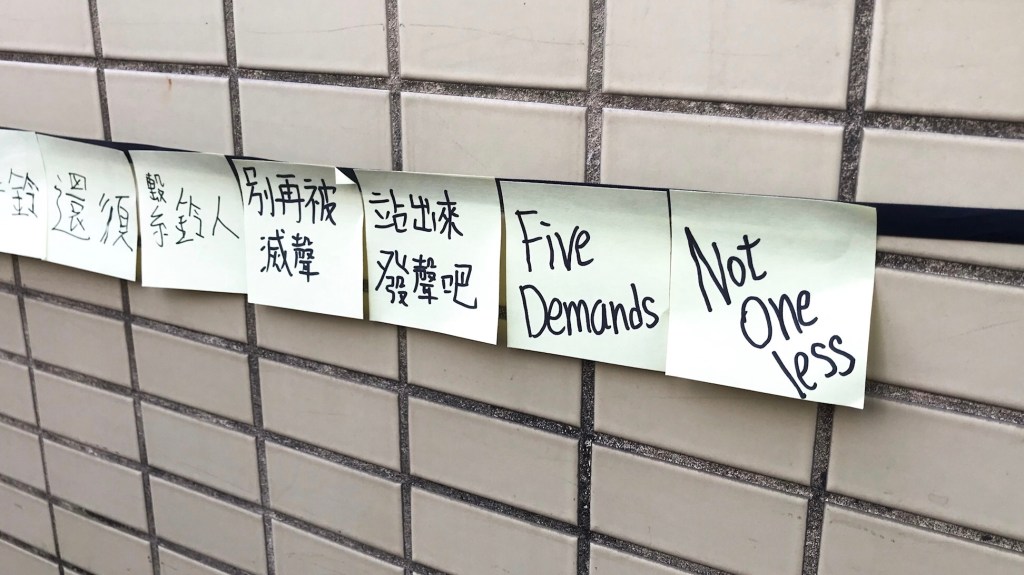
“The rule of law is frail now.”
Guest 1 is a third-year student at HKU, studying Government and Law. She has a passion for photography, travelling, and LEGO. (Head to the Gallery to see some photos she took.)
[Note: This interview was conducted on 23/9/2019, before the incidents that happened on 1/10/2019 and 5/10/2019.]
Alison: Please introduce yourself.
Guest 1: I am a student at the University of Hong Kong. I like photography and LEGO and I like taking up new challenges. I hope to travel around Europe one day. I am driven by my interests and passions, but the motivation can come and go in the blink of an eye. I also tend to overthink sometimes, which makes me rather pessimistic.
Alison: How do you feel about the current political situation in Hong Kong?
Guest 1: Gloomy. I feel like there is no way out. The government and the police force have lost their legitimacy. They won’t be able to rule with a lack of trust by the people and in such a hostile environment. But I also think that this situation has “woken people up” by reminding them that politics and society matter.
Alison: Some say that there are always two sides to an argument, hence they can’t pick which party is “right” in this situation. Do you agree?
Guest 1: Honestly, there are so many ways to approach this question. I can focus on violence, the root cause of the whole issue, “yellow” versus “blue”, whether to support the police or not, whether people should be prosecuted…
Alison: Hm, how about we start with the police?
Guest 1: Very well. I think a big problem is that the police selectively enforce the law. On 21st July, they didn’t show up until the attack by the people wearing white t-shirts was over. They later on asserted that there was insufficient evidence to press charges on the attackers. Ironically, protestors (the people wearing black) were charged immediately for rioting and were sent to court the next day.
There is no way to prosecute the police at the moment. We cannot complain either. We cannot identify who committed a wrong act as we don’t have his/her identification document or number.
Another problem is that “senior” government officials are protecting the police, they are (intentionally) absent whenever the citizens need them.
Alison: There has been reports of the recent use of violence by the police. Some say its arbitrary, an abuse of power. Do you think such “violence” is justifiable?
Guest 1: No, the violence used by the police is not justifiable. Well, it’s not against “equality before the law” that there is a higher standard for police conduct.
We allow the police to use force (legitimately), we allow them to be armed. We do this because we trust that they will protect people and maintain order. This is their duty that comes with the occupation. If they don’t fulfil it, what is the point of having a police force? People don’t even turn to the police when they need help now.
The police bear a duty that comes with the occupation, hence to some extent, their negligent and violent acts are unjustifiable.
Alison: Is it safe to say that the nature of the police force in Hong Kong has changed?
Guest 1: I believe so. They have become political tools, fuelled by hatred and spite. Recently, we have seen several incidents where they torture people. After getting a person to submit to arrest, they beat him after as if they are punishing him. This is contrary the presumption of innocence until proven guilty. The courts should be the ones to judge, not the police.
Alison: What about the government and the rule of law?
Guest 1: Like I said, the government protects the police and condemns the “violent” protestors. That is outrageous.
At its roots, the rule of law enables the monitoring of the government to prevent the arbitrary use of power and to uphold justice so that “normal” or innocent citizens cannot be sent to jail with no good reason or sufficient evidence.
The rule of law is frail now.
Alison: Do you think the media plays a big role in diverting opinions? Does that also make the audience biased?
Guest 1: Yes. And it is sad that people choose to watch, read and believe what they want to. It is also true that we are all biased.
I guess these are just common points anyone can give, I don’t have very specific insight.
Alison: That is completely fine, I just want your honest opinion. What about the protestors? Some people claim that they are violent. Are their “violent” acts justifiable?
Guest 1: I think we all have a bottom line that we won’t cross… Many people have pushed back that line during the movement.
There is a lot of morally “right” or “wrong” considerations. It’s hard to say.
Older generations tend to reject the “violence”. Younger generations are more than happy to explain why it is understandable, perhaps even necessary.
Alison: The incident has been escalating quickly and drastically since June. Did you foresee this?
Guest 1: I honestly don’t see how it’s unforeseeable. At the same time, it’s also ironic. People claim that using violence won’t achieve anything as the government won’t listen anyway. Rationally, the protestors should stop and adopt other methods.
Going back to the question, I think it is foreseeable that there will be increased violence. Given the desperate times, the measures become desperate.
Alison: Do you think protestors that vandalise and destroy property should be prosecuted?
Guest 1: Yes, they should be. But if we analyse this at a deeper level, we can raise the philosophical question of whether people who are trying to overthrow an unjust government should be prosecuted, which would lead to another long discussion.
For now, I agree that people who destroy stuff should be prosecuted.
But what about the police? Who will press charges on them? I want them to face the consequences of their acts.
Unfortunately, there is no sign of any consequence. And their behaviour is getting more and more absurd.
Alison: Why do you think people protest? Why not use other ways to influence the government?
Guest 1: Simply because we have the right to protest, provided by Article 27 of the Basic Law. There is also an abundance of case law, including Yeung May-wan and Leung Kwok Hung. Those with money, power and influence can say anything and people will listen. People like Li Ka-shing have a voice, they have the ability to publish advertisements on several newspapers at the same time.
But what about normal citizens? We have no money, no power. We can only make others listen, especially the government, through “the force of a crowd”. That’s why we protest.
Alison: I see. Some people claim that the protestors have gone too far, do you agree?
Guest 1: From a philosophical perspective, I am inclined to support Dworkin’s view, which advocates that if there is a moral duty to disobey unjust law, there is a moral duty not to punish. This can be applied to civil disobedience. Hence, to some extent, the protesters have not gone too far.
Alison: You mentioned civil disobedience. Can you tell me more about it, given the context of the current situation in Hong Kong?
Guest 1: Well, civil disobedience supposedly brings about legal consequences. It is true that some people want to escape from them.
However, it is arguable whether the certain display of disobedience is civil or uncivil. The extent to which each one of us “tolerates” that act ranges over an overwhelming spectrum. From condemning the act to persuading people to stop, from understanding it to accepting and even supporting it. I also note the difference between understanding and acceptance.
Alison: What do you think is the greatest motivation of such disobedience?
Guest 1: The government’s unresponsiveness and inaction catalysed the disobedience by pushing people to become more violent as there is no other “peaceful” way they can use to express their opinions. It also prompted people to relate better to those “violent” acts.
Going back to your question about taking sides, I can’t really accept how people can be completely “neutral” in this situation.
Alison: Can you elaborate more on why you think so?
Guest 1: First, those “neutral” people think the government and the police are wrong, but the protestors still shouldn’t use violence. I would defend the protestors because the government is the one in power, the members of the government are the only people that can stop this mess. You can’t expect the protestors to help find common ground or to stop because they have already “tried and failed” with all the “peaceful” methods, there is no point in repeating.
Some may argue that my statement is an irresponsible one, but I say there is actually no good rebuttal if one’s mind is already “set” on the belief that nothing could justify any form of violence. This belief completely disregards the context. Frankly speaking, and no offence, it is pretty stupid.
Some people say they don’t care about politics and assert that violence is wrong. I think they really need to read more, to absorb more knowledge before speaking. I’m too tired to argue with people like them.
But I understand the fact that older people (over 50 years old) who disagree with the protestors’ view have been holding this mindset for so many years. I don’t think I can change their perspective in 15 minutes.
I also acknowledge that our morality and “common sense” are being tested every time we watch the news or keep up to date with what is happening.
It’s just really hard to comment without the context, really.
Second, the “neutral” party may think that the government is in the wrong by helping or sympathising the police, but the protestors are damaging what they [the people] have established.
Generally, there is no “black and white” when it comes to controversial matters such as violence and prosecution. That’s why it is important to try to see everything, to look at the big picture.
It is never right for the police to do what they are doing now. Protestors are being prosecuted for their “violent” acts, but what about the police? Are they facing any consequence for their unlawful behaviour?
And seriously the police are just trying to prosecute everyone now. Since they failed to prosecute protestors on the front lines, they prosecute passers-by instead, even a first aider. I have no words.
Alison: Thank you for sharing with us and being so open and honest. I hope the situation will be resolved soon, in the most peaceful way possible.

 Speak Your Mind